
Skip to content
RESEARCH USE ONLY · NOT FOR HUMAN CONSUMPTION · INFORMATIONAL MATERIAL
Illustrative image

Laboratory results, batch by batch

A certificate of analysis shows what was measured in one specific batch. Here you can download the published one and learn how to interpret it.

Certificate issued by the manufacturer

Original manufacturer document (English and Chinese), covering the active ingredient.

COA · active ingredientBatch R20260318
Purity99.38%
Batch
R20260318
Produced
18 Mar 2026
Document language
EN
Certificates
Retatrutide
Read the certificate, line by line
Certificates

Read the certificate, line by line

The published document is a single page of laboratory results. We show it in three phases, from top to bottom, with an explanation of each line. Tap the image to enlarge it.

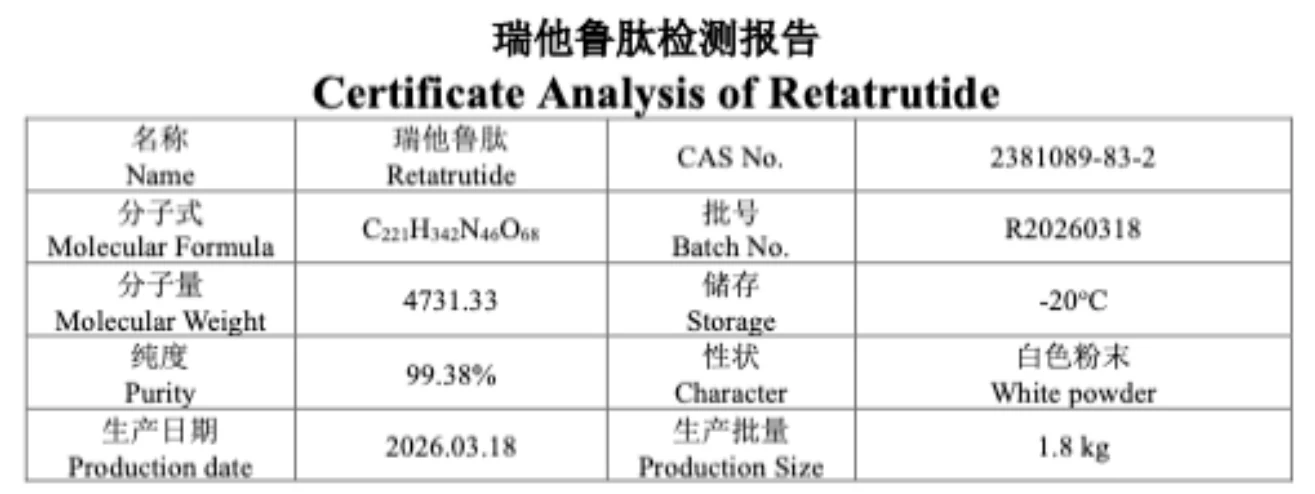
Certificate of analysis for retatrutide, batch R20260318: identification table with name, CAS number, formula, mass, purity, appearance and production date.Enlarge

Phase 1 · Identifying the batch

The header says which material it is, which batch and when it was produced. Before you look at any number, confirm these details.

  • NameName
    Value: Retatrutide

    The material tested: retatrutide, the active ingredient of the pen, as raw material.

  • CAS numberCAS No.
    Value: 2381089-83-2

    International code that identifies a chemical substance. It lets you check that two documents describe the same compound.

  • Molecular formulaMolecular Formula
    Value: C221H342N46O68

    How many atoms of each element make up the molecule. It describes the composition of a molecule, not the quantity of material.

  • Molecular weightMolecular Weight
    Value: 4731.33

    Theoretical mass of the molecule. It is the reference the measured mass is compared with in phase 2.

  • Batch numberBatch No.
    Value: R20260318

    Ties this paper to a specific quantity of material. Another batch has its own analysis and its own results.

  • StorageStorage
    Value: -20 °C

    Temperature at which the raw-material powder was kept. It is not the storage of the finished pen, which is 2 to 8 °C.

  • PurityPurity
    Value: 99.38%

    Of what the method detected, how much is the right molecule. A round 100% almost never appears, because every method has a detection limit.

  • AppearanceCharacter
    Value: White powder

    Visual description of the material: white powder.

  • Production dateProduction date
    Value: 2026.03.18

    When the batch was produced. It is not the expiry date, and one does not replace the other.

  • Production sizeProduction Size
    Value: 1.8 kg

    Total quantity of raw material in this batch. It is not the contents of a pen.
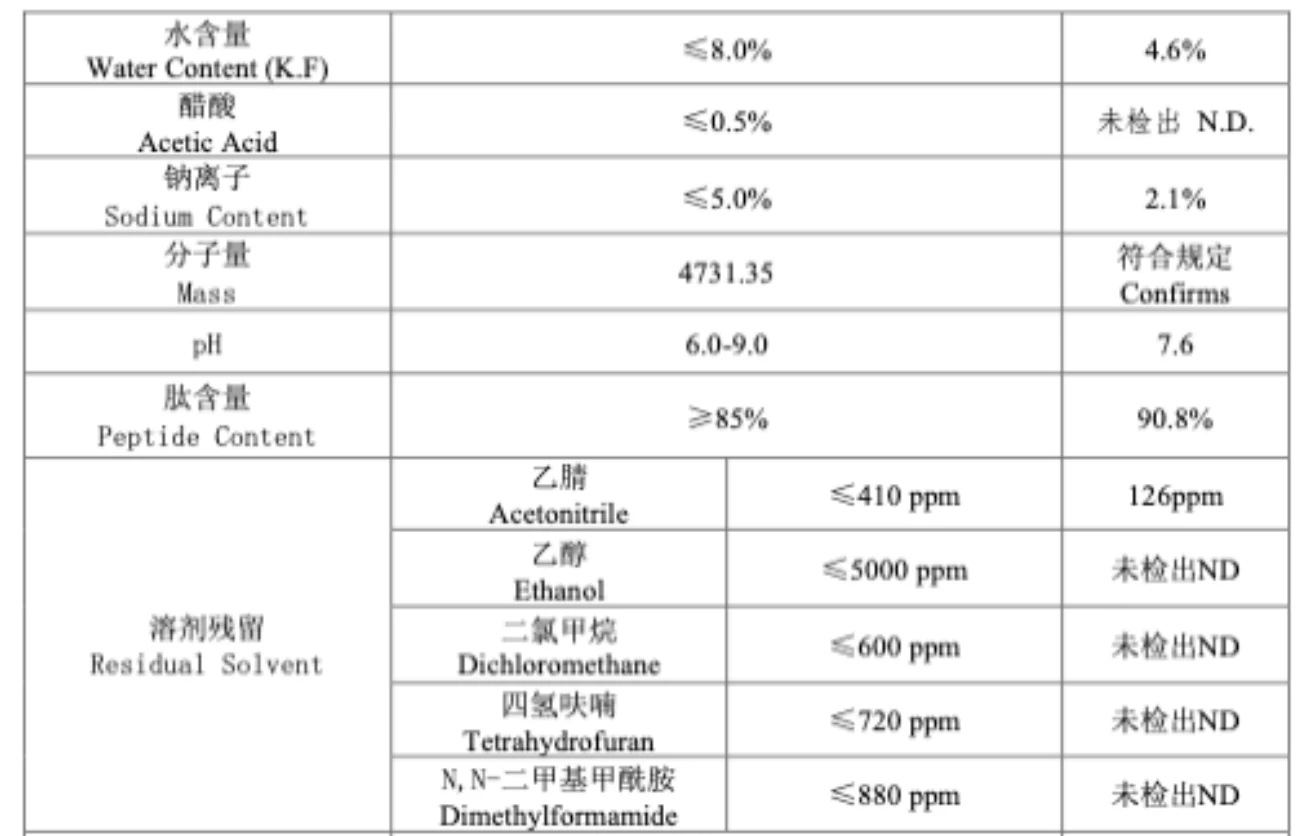
Certificate of analysis, results table: water content, acetic acid, sodium, mass, pH, peptide content and residual solvents.Enlarge

Phase 2 · Composition of the powder

Each row compares the batch result with the limit set before the analysis: reading means checking that the result falls within what was expected. These lines also show why purity and peptide content are different numbers.

  • Water contentWater Content (K.F)
    Specification: ≤8.0%Result: 4.6%

    Water held in the powder, measured by the Karl Fischer (K.F) method. The batch came in below the limit.

  • Acetic acidAcetic Acid
    Specification: ≤0.5%Result: N.D.

    A possible trace from purification. N.D. means “not detected”: the method did not find it above its detection limit.

  • SodiumSodium Content
    Specification: ≤5.0%Result: 2.1%

    Sodium bound to the peptide as a salt. Together with water, it explains why the powder is not 100% peptide.

  • MassMass
    Specification: 4731.35Result: Confirms

    Mass of the main component, measured in the laboratory. “Confirms” means it matches the mass expected for retatrutide and supports the identity of the material.

  • pHpH
    Specification: 6.0-9.0Result: 7.6

    Shows whether a solution of the material is more acidic or more alkaline. The result is within the expected range.

  • Peptide contentPeptide Content
    Specification: ≥85%Result: 90.8%

    Of all the powder that was weighed, how much is peptide; the rest is mostly water and salts. That is why it differs from purity.

  • Residual solventsResidual Solvent
    Specification: ≤410 · ≤5000 · ≤600 · ≤720 · ≤880 ppmResult: 126 ppm · ND · ND · ND · ND

    Liquids that may have been used in production and purification; there are five: acetonitrile, ethanol, dichloromethane, tetrahydrofuran and dimethylformamide. ppm means parts per million; ND, not detected. Only acetonitrile appeared (126 ppm, below its limit); the other four came out ND.

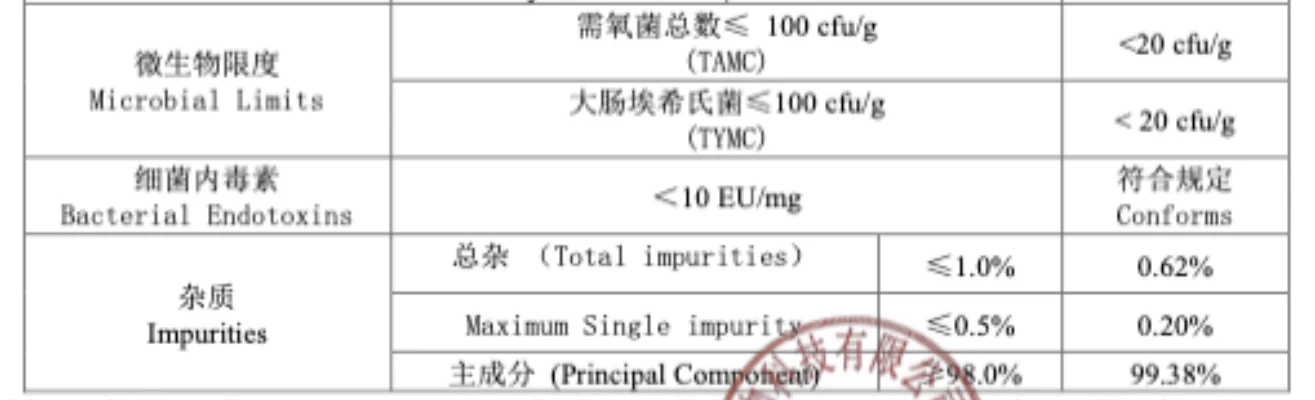
Certificate of analysis: microbial limits, bacterial endotoxins and impurities, with the principal component at 99.38%.Enlarge

Phase 3 · Microorganisms and impurities

The last part shows what the process may have left behind and closes with the split between the main molecule and impurities. The full document, with the laboratory’s signatures and seal, is in the PDF.

  • Total microorganismsMicrobial Limits (TAMC)
    Specification: ≤100 cfu/gResult: <20 cfu/g

    Total count of aerobic microorganisms per gram (cfu/g: colony-forming units). The “<” sign means the result fell below 20, and the limit is 100.

  • Yeasts and mouldsMicrobial Limits (TYMC)
    Specification: ≤100 cfu/gResult: <20 cfu/g

    Total count of yeasts and moulds, read the same way as the line above.

  • Bacterial endotoxinsBacterial Endotoxins
    Specification: <10 EU/mgResult: Conforms

    Fragments of the wall of certain bacteria. “Conforms” means the result is in line with the limit of less than 10 EU/mg.

  • Total impuritiesTotal impurities
    Specification: ≤1.0%Result: 0.62%

    Everything detected that is not the main molecule. Added to the purity it makes 100% (0.62 + 99.38).

  • Largest individual impurityMaximum Single impurity
    Specification: ≤0.5%Result: 0.20%

    Helps tell apart two situations that look alike in the total: many tiny impurities or a single one that stands out.

  • Principal componentPrincipal Component
    Specification: ≥98.0%Result: 99.38%

    The molecule being sought. It repeats the purity figure from phase 1 and compares it with its minimum of 98.0%.

Full certificate as a PDFThe PDF holds the whole page as the manufacturer issued it, including the laboratory identification, the signatures and the seal.

How to read a certificate of analysis: what each line means

Is your batch not on the list?

Send us the batch number printed on the box via WhatsApp and we will help you locate its certificate.