 Presented by PAY FIT


What is a peptide: from the amino acid sequence to the receptor
A peptide is a short chain of amino acids whose sequence decides which receptor it binds to. See how it forms, how it differs from a protein, and why synthesis and purity matter.
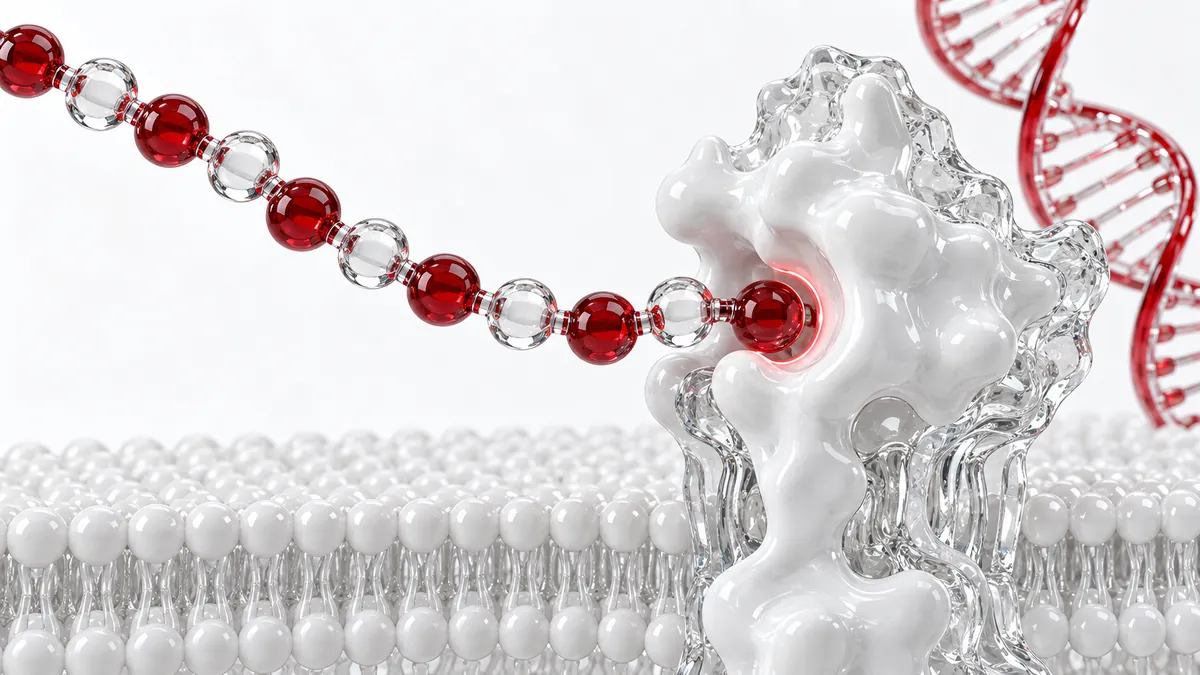
A peptide is a short chain of amino acids joined together, and the order of those amino acids, the sequence, determines the shape of the molecule and, with it, the receptor it can fit. That fit is what turns a sequence written in letters into a biological message.
Amino acids and the peptide bond: how the chain forms
Amino acids are small molecules with an amino group at one end and a carboxyl group at the other, plus a variable part, the side chain, which gives each one its character: more or less affinity for water, a positive or negative electrical charge, bulk. The human body uses 20 standard amino acids as a kind of alphabet.
When the carboxyl group of one amino acid reacts with the amino group of the next, a peptide bond forms and a molecule of water is released. Repeated many times, this reaction builds a chain with a set direction, running from the amino end (N-terminus) to the carboxyl end (C-terminus). Order matters: the same amino acids in a different sequence make a different molecule.
The combinations multiply quickly. A chain of just five positions, with 20 options at each, already allows 3.2 million different sequences.
Peptide or protein: a matter of size and structure
In practice, what separates the two is the length of the chain. A chain from a few amino acids up to about 50 is usually called a peptide, and a longer one a protein. The cut-off is a convention, not a rigid boundary in nature.
Size brings differences in structure. A short peptide is often flexible and adjusts as it approaches its target. Long proteins fold into stable, complex three-dimensional arrangements, frequently made of more than one chain, and work as enzymes, supporting structures or carriers. Broadly speaking, a protein is building material and machinery; a peptide is, quite often, a signal.
The sequence defines the receptor: lock and key
Cells carry receptors, proteins on the surface or inside, with a binding region of a specific shape and charge pattern. The peptide's sequence sets its profile, and only a peptide with a matching profile attaches to the receptor and triggers the cell's response. This is the familiar image of a lock and key.
The image is a useful simplification. In reality, peptide and receptor adjust to each other when they meet, and swapping a single amino acid can change the strength of binding or even the kind of response. That is why a sequence has to be exact to do what is expected of it.
Examples from the body itself
Many of the body's messengers are peptides. Here are three well-known examples:
| Peptide | Amino acids | Known role |
|---|---|---|
| Insulin | 51, in two chains | Made in the pancreas; takes part in controlling blood glucose |
| Glucagon | 29 | Made in the pancreas; acts against insulin on glucose |
| Oxytocin | 9 | Made in the hypothalamus; takes part in childbirth and breastfeeding |
Insulin illustrates the borderline well: with 51 amino acids in two chains, it is called a peptide hormone even though it sits at the edge of the usual size range. Oxytocin, with only nine, shows how a short chain can carry a precise instruction.
Why production and purity matter
Because the slightest change of amino acid alters how a molecule behaves, the way it is made is part of the subject. Laboratory peptides are usually produced by solid-phase chemical synthesis: the chain is assembled one amino acid at a time while anchored to a resin. Faults can creep in at each step, and truncated sequences appear, with a missing amino acid or with protecting groups that did not come off, mixed in with the wanted product.
For this reason there are two stages. In purification, normally by preparative liquid chromatography, the wanted product is separated from those impurities. In analysis, two techniques complement each other: HPLC (high-performance liquid chromatography) separates the components of the sample and allows purity to be estimated, and LC-MS links that separation to a mass spectrometer, which confirms whether the mass of the molecule matches that of the expected sequence. HPLC shows how much of the sample is a single component; LC-MS confirms that this component is what it should be.
In general, the purity and identity of a peptide are checked in the laboratory with chromatography and mass spectrometry techniques (HPLC and LC-MS, for example). A certificate of analysis states what was measured and against which specification, and knowing how to read one is a useful skill: see how to read a certificate of analysis. To learn about the production and control routine, there is also the factory page.