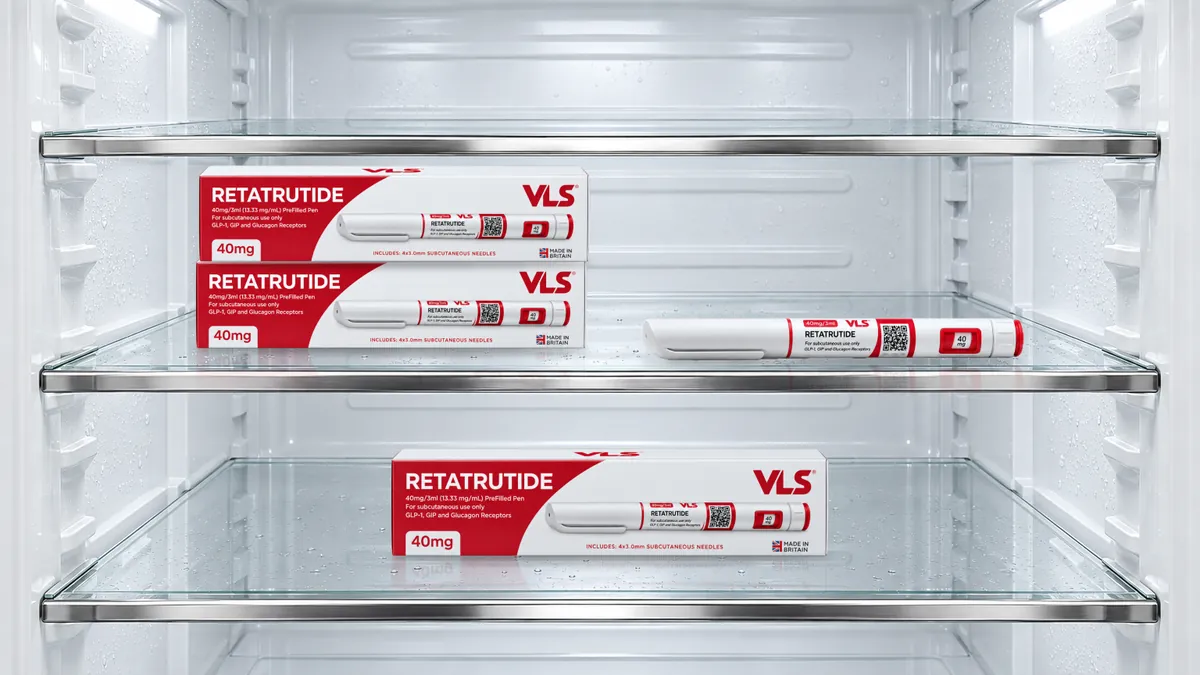
 Presented by PAY FIT


Reading the label with confidence: milligrams, millilitres and concentration
What milligrams, millilitres and concentration mean, why 40 mg in 3 mL gives 13.33 mg/mL, and what the batch number, expiry date and verification code on the box are for.
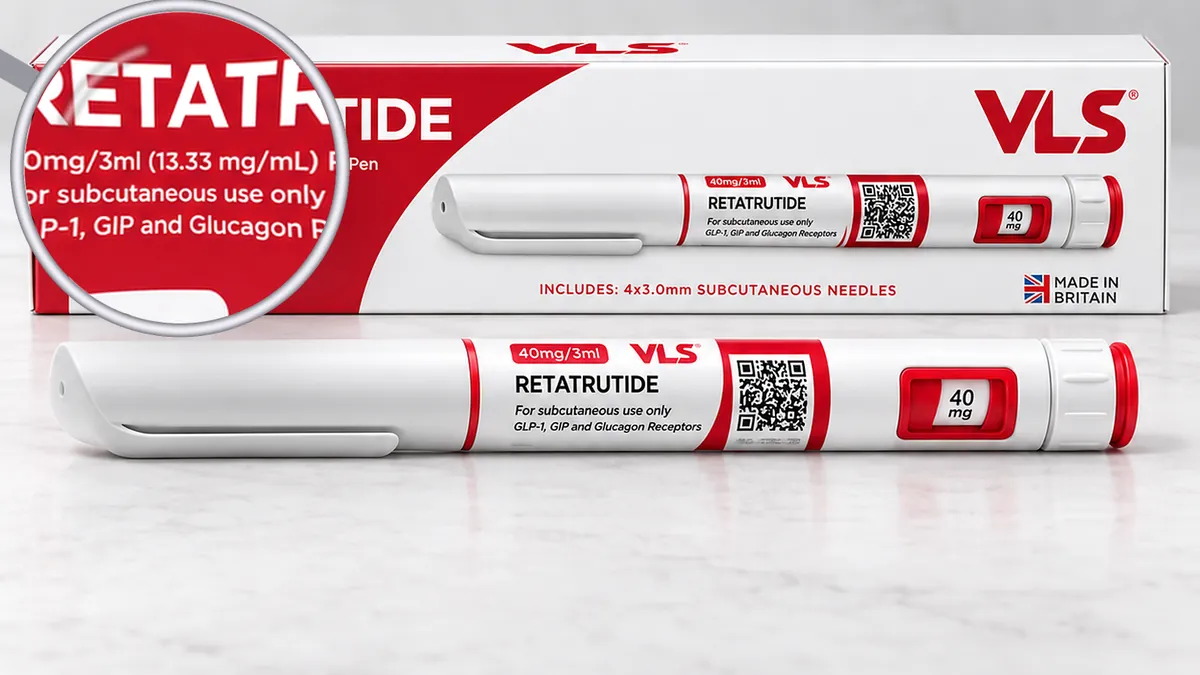
The label on the retatrutide pen brings together three figures that are easily mixed up: milligrams (mg) show how much active substance there is, millilitres (mL) show how much liquid there is, and concentration (mg/mL) links the two. On the VLS pen the figures are 40 mg in 3 mL, which works out at 13.33 mg per millilitre. Below you can see how that value is reached and what each item printed on the box tells you. Product details are on the 40 mg retatrutide pen page.
Three figures, three different questions
Milligrams answer the question “how much active substance is in here?”. On the pen, 40 mg is the total amount of retatrutide in the device, not the weight of the solution.
Millilitres answer “how much liquid is it?”. The 3 mL is the volume of the solution in which those 40 mg are dissolved.
Concentration answers “how much substance is in each millilitre?”. It is the figure that lets you compare different presentations with one another.
It is worth keeping these units apart from others seen in medicines. The International Unit (IU) measures biological activity and cannot be turned into milligrams by any universal rule, and the “units” scale on some syringes marks volume, not quantity of substance. On this pen the label works in milligrams and millilitres.
The division behind 13.33 mg/mL
Concentration comes from a simple division: the total amount divided by the total volume.
Concentration = 40 mg ÷ 3 mL, or 13.33 mg/mL
The exact result is 13.333…, rounded to two decimal places. It reads like this: every millilitre of the solution holds 13.33 mg of retatrutide, and the three millilitres together add up to the 40 mg stated on the box.
The sum also shows why looking at milligrams alone can mislead. Two presentations with 40 mg in total have different concentrations if the volume changes: 40 mg in 2 mL would be 20 mg/mL. That is why a label is always read with both figures together.
What each item on the label tells you
| Item | What it tells you |
|---|---|
| 40 mg | Total amount of retatrutide in the pen |
| 3 mL | Total volume of the solution |
| 13.33 mg/mL | Concentration: the result of 40 ÷ 3 |
| Batch number | The production run of the unit; links it to its certificate of analysis |
| Expiry date | Last date of use set by the manufacturer |
| 2–8 °C | Storage range in the refrigerator |
| Verification code | Lets you check that the unit is original |
| Seal | Shows that the box has not been opened before |
Batch number, expiry date and verification code
The batch number identifies the production run your pen came from. It is the key to finding the matching certificate of analysis. The published material is in the lab reports section, and how to read a certificate of analysis explains what to look at on each line.
The expiry date is the date up to which the manufacturer stands behind the unopened, properly stored product. The stated shelf life is 24 months, and the date that applies to your unit is the one printed on the box. Once that date has passed, the pen should not be used. Storage conditions are covered in cold, light and time.
The verification code is there to check that the unit is genuine. You look it up on the verification page. If the result does not match what you are holding, do not use the pen and write to us through the contact page, quoting the batch number.
How the pen shows the setting in its window
The pen is multi-dose and has a display window that shows the selected setting. The mechanism takes care of the volume, so there is nothing to convert between milligrams and millilitres when using it. Read the window exactly as it appears, in the unit it shows, and do not convert it yourself from the concentration.
The setting and the frequency are decided by the health professional who follows each person. This article explains how to read the label, not which setting is appropriate. To see how the window is interpreted, visit the page on concentration and reading the display.
For information only; it does not replace the advice of a health professional.