 Presented by PAY FIT


Cold, light and time: how to keep your pen in good condition
Refrigerator at 2 to 8 °C, away from light and heat, never frozen or shaken. Why the peptide is delicate, what takes its potency away, how to look after it at home and when travelling, and what to do if it was left out.
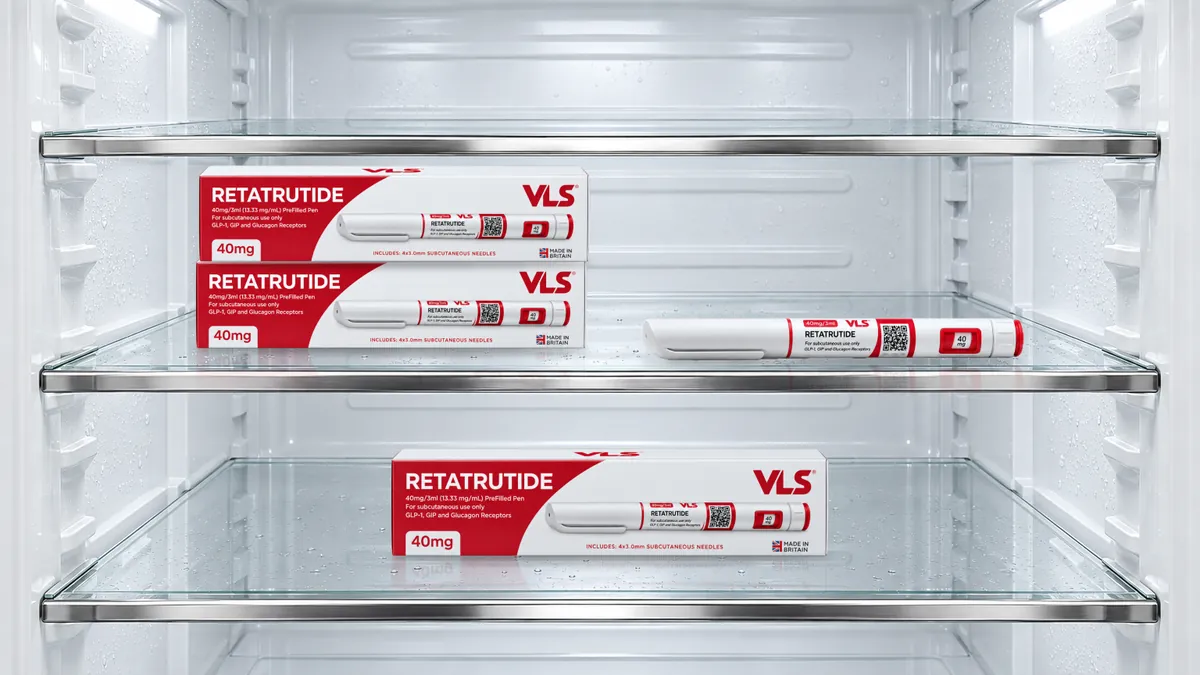
The retatrutide pen is kept in the refrigerator at 2 to 8 °C, away from direct sunlight and heat, and it must never be frozen. If it has frozen, it is not used, even if it looks normal afterwards. That is the essence of it. The rest of this article explains the reasons and what to do at home, when travelling and when something goes wrong.
The range that matters: 2 to 8 °C
The retatrutide in the pen is in solution, a form that needs no preparation but does need care with temperature. Outside the stated range, a molecule of this kind can degrade without any visible sign.
- Keep the pen in its original box: it shields the contents from light and keeps the batch number and expiry date to hand.
- Inside the refrigerator, pick a middle shelf. The door changes temperature every time it is opened, and the back wall sometimes builds up ice.
- Always leave it in the same place, so you do not have to move it or hunt for it.
- A refrigerator thermometer helps confirm that the range is being kept.
Why the peptide is delicate (and what takes its potency away)
A peptide is a short chain of amino acids that has to keep its shape in order to work. Inside the pen there is an enormous number of these chains, floating freely in the liquid. When they are treated roughly, two things happen: some stick to one another and form clumps too small to see, which laboratories call aggregation; others break apart or change chemically, which is called degradation. A clumped or broken chain no longer fits its receptor properly, and the result is a pen that loses potency even though the liquid still looks clear.
Scientific reviews of medicines made from proteins and peptides keep pointing to the same factors: temperatures outside the range, hard shaking, freezing and thawing, and ultraviolet light. Aggregated chains lose activity and, on top of that, the body may recognise them as something foreign.
- Shaking hard. Shaking the pen creates foam and bubbles. Where air meets liquid, the chains unfold and stick together. If you need to move it, do so gently.
- Freezing. Some people keep the pen in the freezer thinking it will last longer, and the opposite is true: ice crystals and thawing pull the structure apart and encourage clumps. A pen that has frozen does not recover when it thaws and must not be used, even if the solution looks the same.
- Light. Direct sun and ultraviolet light can oxidise parts of the chain. The box and the cap protect it: always keep the pen inside its box.
- Heat and time out of the refrigerator. Heat speeds up all of these reactions. The inside of a car in the sun, a backpack next to a heat source or the worktop beside the oven are places to avoid, even briefly. And once you have started using it, the pen goes back in the refrigerator after each use: leaving it out for hours or days gradually takes its strength away.
- Knocks. A hard fall can crack the cartridge or damage the mechanism. If in doubt, check it before use.
In practice this is easy to misread: someone who stored the pen badly may think the product “doesn’t work”, when in fact it lost potency along the way. Care is part of using it.
If the peptide comes as a powder: twice the care
Some products sold outside a ready-to-use presentation come as a powder (lyophilised) and have to be mixed with bacteriostatic water before use. That raises the risk, because people mix it themselves and every step is a chance to damage the peptide or contaminate the vial. A study on reconstituting protein medicines found more aggregates in vials that were shaken hard while mixing. So in those cases the rule is: washed hands and a rubber stopper wiped with alcohol, new materials, mixing by swirling the vial gently without shaking it, and keeping the mixture in the refrigerator. A multi-dose vial does not last forever once opened, either: the injection safety recommendations of the US CDC say to date it and throw it away after 28 days unless the manufacturer gives another date. The VLS pen skips that stage altogether: it arrives in solution, ready, with a defined concentration.
Expiry date and appearance: what to check before use
The manufacturer states a shelf life of 24 months for the unopened product kept under the stated conditions. The date that applies to your unit is the one printed on the box, and it cannot be stretched: once it has passed, the pen should not be used.
Before each use, look at the solution and the cartridge. Do not use the pen if:
- the solution is cloudy, contains particles or has changed colour;
- the cartridge is cracked or leaking;
- you know or suspect that it was frozen or exposed to heat;
- the printed expiry date has already passed.
Once a pen has been put into use, the period and conditions that apply are those in the manufacturer's instructions, which come in the box. Follow those instructions rather than a generic figure for another product, because every formulation has its own stability study. Writing the date of first use on the box is a good habit. How to handle the device is covered in the guide to using the pen.
Travelling and receiving your order
When you travel, use a cool bag with a cooling gel pack and place a cloth between the gel and the pen, so there is no direct contact with intense cold and the pen does not freeze. On a plane, carry it in your hand luggage, where you can keep it in sight and under control. On arrival, put it back in the refrigerator as soon as you can.
The same reasoning applies to delivery: transport has to maintain the cold chain. When your order arrives, check that the seal is intact, note the batch number and put the pen in the refrigerator straight away. If the parcel arrived warm, or if you do not know how long it went without refrigeration, treat it as the case in the next section.
If the pen was left out of the refrigerator
This is not a case for improvising: no testing it, no judging by eye whether it is “still fine”, and no carrying on as if nothing had happened. The prudent course is to set it aside, keep it in the refrigerator away from your other items and not use it until you have an answer.
Write to us through the contact page and give the batch number, how long the pen was out of the refrigerator, where it was and, if you know it, the approximate temperature of the place. With that information each case is assessed on its own. Other questions about orders and shipping are in the frequently asked questions, and for the meaning of each item on the box, see reading the label.
Sources
- Rahban M, et al. Stabilization challenges and aggregation in protein-based therapeutics in the pharmaceutical industry. RSC Advances, 2023. PMC10711991
- Zapadka KL, et al. Factors affecting the physical stability (aggregation) of peptide therapeutics. Interface Focus, 2017. PMC5665799
- Peters BJM, et al. mAbs, 2013;5(1):162-170 (a study on preparing antibody vials, including the effect of shaking them hard). PMC3564881
- CDC. Preventing Unsafe Injection Practices, 2024. cdc.gov
- Storage at 2 to 8 °C and 24-month shelf life: manufacturer’s data (VLS).
For information only; it does not replace the advice of a health professional.