 Presented by PAY FIT


One, two or three receptors: how retatrutide differs from other peptides
What each receptor does (GLP‑1, GIP and glucagon), how the peptide fits its receptor and passes the signal into the cell, and how a three-target peptide differs from one- or two-target peptides, in plain language.

Retatrutide differs from other peptides in its family in one concrete way: it activates three receptors at once (GLP‑1, GIP and glucagon), whereas simpler peptides activate one or two. This article moves from the simplest case to the fullest, so that you can read a study knowing what each abbreviation means.
What a target is, and what an agonist does
A receptor is a protein on the surface of a cell. It works like a lock: when the right molecule fits, the cell receives a signal. An agonist peptide has the right shape to fit that receptor and switch it on, much as a natural hormone would. When people speak of a “target”, they mean that receptor, the place the peptide is aimed at.
A triple agonist is not a blend of three products. It is a single molecule designed to activate three different receptors. That is where the idea of one-, two- and three-target peptides comes from.
From key to message: how the peptide signals the cell
Think of the receptor as a lock with a doorbell built into the wall of the cell: one part sits outside and another inside. The peptide is the key. It travels in the blood, finds its receptor and fits into the outer part. That fit slightly changes the shape of the receptor, and the change is felt on the inside, just as turning a key moves the mechanism behind the door.
On the inside a co-worker is waiting: a protein called a G protein. When the receptor changes shape, it wakes this protein up and calls it to work. The co-worker in turn switches on an enzyme that makes many copies of a small messenger, cyclic AMP. The messenger travels through the cell and asks other proteins to do their part: in the pancreas, for example, it helps release insulin when there is glucose in the blood; in the brain, it takes part in the feeling of fullness.
The interesting part is the chain reaction. A single key in a single receptor puts one co-worker to work, which activates many messengers, which in turn mobilise many more proteins. A small signal outside ends in a large response inside: biology textbooks call this signal amplification.
Retatrutide is one key shaped to fit three different locks. Those locks sit in different cells (in the pancreas, the brain, fat tissue and the liver), and in each one the message inside leads to a different job. That is why a single molecule can talk to several organs at once. How much each pathway counts in people is still being studied.
GLP‑1: fullness and glucose control
The GLP‑1 receptor is the starting point for the whole family. When it is activated, several things happen side by side: the brain receives a fullness signal and appetite falls, the stomach empties more slowly after a meal, and the pancreas releases insulin in proportion to the glucose in the blood. One-target peptides work along this axis of appetite and glucose.
GIP: the second receptor
GIP is another gut hormone, released after meals. It takes part in insulin secretion and has receptors in the pancreas, but also in fat tissue and in the brain. Two-target peptides add this receptor to GLP‑1. How much each contributes on its own, and how the two work together, is still an active area of research, and it is worth saying so with due caution.
Glucagon: the third receptor and energy expenditure
Glucagon is known above all for its role between meals, when it helps the liver release glucose. It is also associated with higher energy expenditure and with the use of fat as fuel. Retatrutide adds this receptor to the other two, and it is the component that simpler peptides lack.
It is a delicate balance: glucagon on its own raises glucose, which is why, in this design, it acts alongside the activity at GLP‑1 and GIP. A useful way to picture the whole: appetite and glucose on one side, energy expenditure on the other.
One, two and three targets side by side
The table sums up the comparison. It is a teaching simplification: each molecule also has its own structure and its own profile.
| Feature | One target | Two targets | Three targets |
|---|---|---|---|
| Receptors activated | GLP‑1 | GLP‑1 and GIP | GLP‑1, GIP and glucagon |
| Axes involved | Appetite, fullness and glucose | The same, plus the action of GIP on insulin and fat tissue | The earlier ones, plus energy expenditure and use of fat |
| What it adds to the previous step | It is the starting point | A second receptor, that of GIP, a gut hormone | A third axis, that of glucagon |
| In one sentence | One pathway | Two pathways that complement each other | Three pathways in a single molecule |
What the studies say, and what they do not
The phase 3 programme called TRIUMPH brings together several trials with thousands of participants. The results reported describe, on average, a fall in body weight among the groups that received the molecule, greater than among the comparison groups that received a placebo. These are group averages, obtained under controlled conditions; they do not predict what will happen to any one person.
Having more targets does not make a molecule superior by definition. Each receptor adds possibilities and also more variables to study, tolerability among them. In the studies, the most frequent effects were digestive: nausea, diarrhoea, constipation and vomiting. Anything involving amount, frequency or follow-up is decided by a healthcare professional.
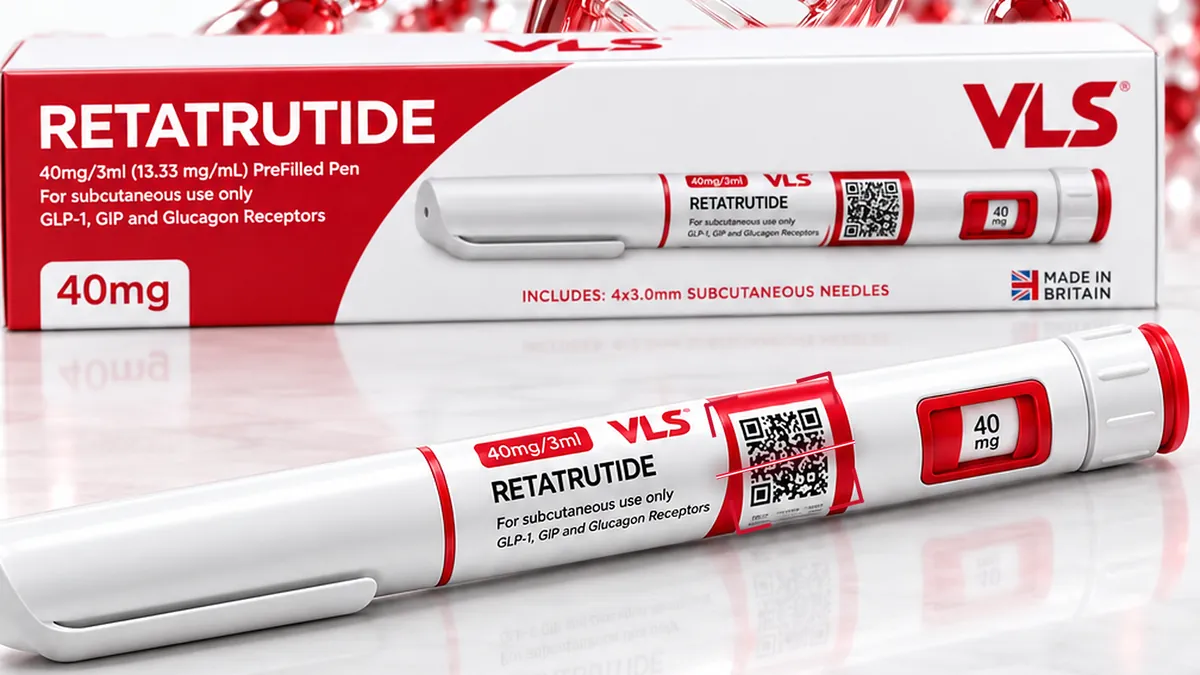
To keep reading: how evidence is built, phase by phase, and what the trials measured. Details of the VLS retatrutide pen are on its product page.
Sources
- Müller TD, et al. Glucagon-like peptide 1 (GLP‑1). Molecular Metabolism, 2019. PMC6812410
- Campbell JE. Targeting the GIPR for obesity: to agonize or antagonize? Potential mechanisms. Molecular Metabolism, 2021. PMC8085569
- McGlone ER, Bloom SR, Tan TM. Glucagon resistance and metabolic-associated steatotic liver disease: a review of the evidence. Journal of Endocrinology, 2024. PMC11067060
- Coskun T, et al. LY3437943, a novel triple glucagon, GIP, and GLP‑1 receptor agonist. Cell Metabolism, 2022. doi:10.1016/j.cmet.2022.07.013
- OpenStax, Biology 2e (open textbook), 9.2 Propagation of the signal. openstax.org
For information only; it does not replace the advice of a healthcare professional.